Kitchen Tables and Garden Sheds: The Freelance Revolution Quietly Changing How Nottinghamshire Works

The Office Was Never Really the Point
There's a particular kind of Tuesday morning that a lot of Nottinghamshire freelancers know well. The kettle's on, the laptop's open, and the view from the kitchen window is doing more for creative thinking than any open-plan office ever managed. No commute. No hot-desking lottery. No passive-aggressive notes about the communal fridge.
For a growing number of independent creatives across the county — graphic designers, copywriters, photographers, illustrators, web developers — this isn't a temporary workaround. It's the whole plan.
And what's interesting isn't just that people are working from home. It's what they're building around it.
From the Lace Market to the Living Room
Nottingham's Lace Market has long been shorthand for creative ambition in the East Midlands. The Victorian textile warehouses turned studios and agencies gave the area a genuine identity — a place where independent thinkers clustered together, fed off each other's energy, and occasionally poached each other's clients over a flat white.
That model still exists, and it still works for plenty of people. But something has shifted. The freelancers coming up now — and plenty of seasoned ones reassessing their priorities — aren't necessarily gravitating towards the co-working hub or the shared studio. They're finding that the community they actually need doesn't require a postcode.
Take the number of informal creative collectives that have quietly assembled themselves across the county over the past few years. A handful of illustrators in Hucknall who share a group chat, split software subscriptions, and meet monthly at a local café. A loose network of videographers and sound designers around Newark who refer work to each other and occasionally collaborate on bigger briefs. None of these are formal businesses. None have a lease or a logo. But they function like professional communities in every meaningful sense.
Why Unconventional Bases Are Working
Part of what's driving this shift is practical. Commercial workspace in Nottingham city centre isn't cheap, and for a freelancer whose client base is increasingly remote anyway, the maths simply don't add up. Why pay for a desk near the tram stop when your biggest client is in Manchester and your second biggest is in Berlin?
But it's not just economics. There's a growing sense among creative freelancers that the traditional workspace model was solving a problem they didn't actually have — the problem of proximity — while creating new ones around rigidity, cost, and the subtle pressure to perform productivity for an audience.
The garden studio, by contrast, offers something different. It's a dedicated space without the overhead. The café arrangement — a regular table at a trusted local spot, a familiar face behind the counter, the ambient noise that somehow helps more than silence — gives structure without obligation. These aren't compromises. For a lot of people, they're genuinely better.
Staying Connected Without a Workplace
The obvious question is: doesn't this get lonely? And the honest answer is yes, sometimes. Anyone who's spent a full week working solo will tell you that the lack of casual human contact — the corridor chat, the shared lunch, the moment someone else laughs at something — leaves a gap that Slack notifications don't really fill.
What's emerging across Nottinghamshire, though, is a set of informal structures that address exactly this. Monthly meetups at independent coffee shops. WhatsApp groups that mix professional chat with the kind of low-stakes banter that makes work feel less isolating. Skill-swap arrangements where a photographer trades headshots for a copywriter's website refresh. Small, practical, human-scale connections that add up to something surprisingly robust.
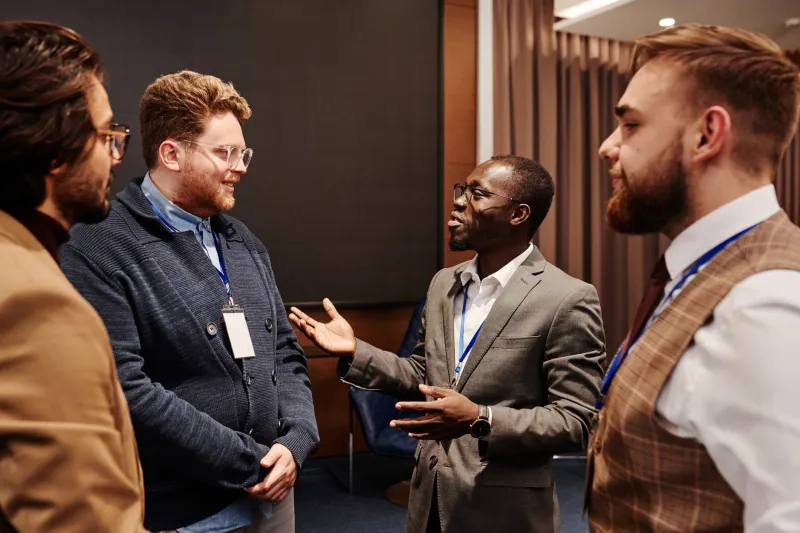
Some of the county's more established networking groups have noticed this too. Events that used to draw mostly small business owners and sole traders are increasingly attracting freelancers who aren't looking to pitch or be pitched at — they just want to be around other people who understand what it's like to invoice for a living.
That's not nothing. In fact, for a lot of freelancers, it's exactly what they need.
The Micro-Community Model
What this all points to is something that doesn't have a tidy name yet, but is starting to look like a distinct feature of how creative work organises itself in places like Nottinghamshire. Call it the micro-community model: small, self-organising clusters of independent workers who share knowledge, support, and occasional work, without any of the formal infrastructure that usually comes with the word "network."
These groups tend to form around shared tools, shared clients, shared frustrations, or simply shared geography. They're not exclusive — people drift in and out as projects and priorities shift. And because they're not built around a single venue or organisation, they're remarkably hard to kill. When the café closes, the group moves. When someone relocates to Southwell or West Bridgford, the group chat follows.
There's an argument — and it's a compelling one — that this dispersed, low-overhead approach is actually building a more resilient professional community than the traditional model ever did. Formal co-working spaces come and go. Business networking clubs rise and fall with their organisers' enthusiasm. But a group of ten freelancers who genuinely rate each other and know each other's work? That tends to stick around.
What This Means for Nottinghamshire's Creative Scene
None of this means the Lace Market is finished, or that co-working is going away. For plenty of people — especially those earlier in their careers, or those who genuinely thrive in a shared environment — a desk in a creative hub is worth every penny. The point isn't that one model has beaten another. It's that the range of options has quietly expanded, and Nottinghamshire's freelancers are making the most of it.
What's worth paying attention to is the culture this is creating. A county full of independent workers who've had to build their own professional communities from scratch tends to produce people who are pretty good at connecting with others, at being generous with referrals, and at treating work as something that fits around life rather than the other way around.
That's a healthy thing. And if it's happening at kitchen tables and in garden sheds across Nottinghamshire, then honestly — good. The work's getting done. The connections are being made. And nobody's arguing about the thermostat.