Same Faces, Missed Chances: The Representation Problem Sitting in Plain Sight Across Nottinghamshire's Networks
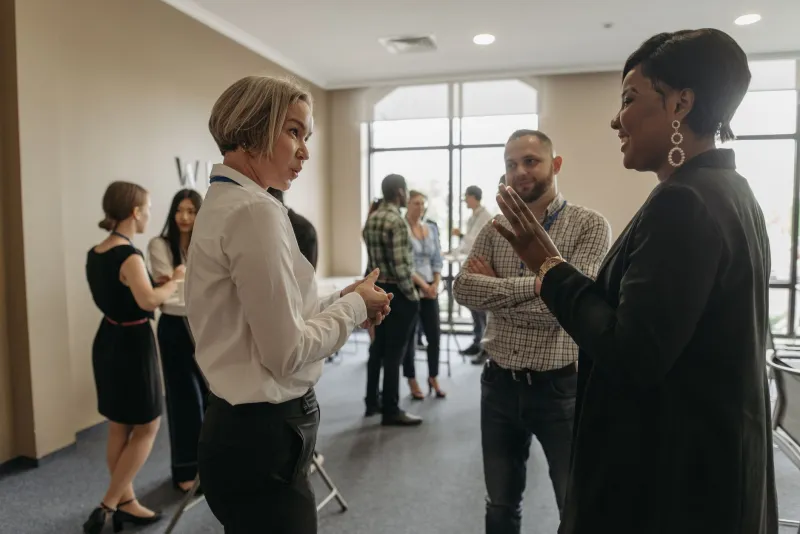
The Room That Doesn't Lie
There's a particular moment that several professionals described to us in almost identical terms. You walk into a networking event — a breakfast briefing, a chamber mixer, a sector roundtable — scan the room, and feel that familiar flicker of calculation. Who here looks like me? How many of us are there? What does that tell me about whether I belong?
For Priya, a financial consultant based in Nottingham city centre, that moment stopped being surprising years ago. "I've been going to professional events across the East Midlands for over a decade," she says. "The rooms have got slightly more diverse in that time, but only slightly. And there's a difference between a room that's technically more diverse and one where everyone actually feels like they're supposed to be there."
That distinction — between surface-level diversity and genuine inclusion — is the fault line running through Nottinghamshire's networking landscape right now. And while many group leaders acknowledge the issue, fewer have meaningfully changed what they do about it.
The Gatekeeping Nobody Admits To
The barriers aren't always obvious. Nobody's standing at the door turning people away. But invisible gatekeeping — the kind that operates through assumptions, informal referrals, and unexamined habits — is arguably more stubborn precisely because it's harder to name.
Take the way many groups still grow: word of mouth, a tap on the shoulder, someone recommending a colleague they already know. In a county where professional circles are tight and long-established, that model consistently reproduces the same demographic profile. "If everyone in your existing network looks the same," says Marcus, who runs a small business support consultancy in Mansfield, "then word-of-mouth recruitment just amplifies that. It's not malicious. It's just how networks self-replicate."
There's also the question of cost. Entry fees, membership subscriptions, and the soft costs of attending events — parking, smart clothes, the price of a round of drinks — create genuine friction for professionals from lower-income backgrounds or those earlier in their careers. A £45 monthly membership might feel trivial to an established director; for someone building a business from scratch, it's a meaningful barrier.
Then there's timing. Early-morning breakfasts and after-work drinks are the twin pillars of professional networking in Nottinghamshire, as elsewhere. But those formats systematically disadvantage people with caring responsibilities, those working multiple jobs, or those whose faith practices shape their schedule. "Nobody designed these events to exclude anyone," says Fatima, a marketing professional from Arnold. "But when you never interrogate the format, you end up with the same people turning up every time."
What Group Leaders Actually Say
We spoke to several organisers running networking groups across Nottinghamshire, and to their credit, most were willing to be candid. The honest ones acknowledged that intention and outcome aren't the same thing.
"We've said for years that we're open to everyone," admitted one long-running group leader who asked not to be named. "But open-door isn't the same as actively welcoming. We hadn't done the work to understand why certain people weren't coming — we just assumed they weren't interested."
That passive approach — waiting for diversity to arrive rather than creating conditions for it — is common. And it tends to coexist with a genuine belief that the group is already inclusive. The cognitive dissonance is real, and it makes change slow.
Some groups have started to shift. A few Nottinghamshire organisations have introduced tiered pricing, online attendance options, and daytime formats specifically to reach professionals who don't fit the traditional mould. Others have partnered with community organisations — grassroots business support groups, cultural networks, university enterprise schemes — to actively recruit from different pools.
What Actually Works
The organisations making real progress tend to share a few characteristics. First, they've stopped treating diversity as a communications problem and started treating it as a structural one. Posting more inclusive imagery on social media doesn't change who feels comfortable walking through the door; changing the format, the pricing, the timing, and the leadership does.
Second, they've brought underrepresented professionals into positions of genuine influence — not as token voices on a panel, but as committee members, co-chairs, and programme designers. When the people shaping an event reflect a broader range of experiences, the event itself tends to follow.
Third, they've been willing to ask uncomfortable questions publicly. One Nottinghamshire business group recently surveyed non-members — specifically people who'd attended once and not returned — to understand what had put them off. The results were instructive and, by the group's own admission, uncomfortable reading. But acting on them shifted the membership profile measurably within a year.
The Business Case Isn't the Only Argument
It's tempting to frame all of this in terms of the business case for diversity — and that case is real. Homogeneous networks miss talent, miss market insights, and miss opportunities. But reducing inclusion to a commercial argument has its own problems. It makes diversity instrumental rather than intrinsic, and it lets organisations off the hook the moment the ROI feels unclear.
The stronger argument, perhaps, is simpler: Nottinghamshire's professional community is supposed to represent Nottinghamshire. A county that is genuinely varied — in background, in age, in experience, in ambition — deserves networks that reflect that variety. Not because it's good for business (though it is), but because that's what a professional community actually is.
The talent is there. It always has been. The question is whether the structures are ready to meet it.
Where to Start
For any group leader reading this and wondering where to begin, the professionals we spoke to offered consistent advice: ask, listen, and then actually change something. Not a working group. Not a statement of intent. Something concrete — a different time slot, a subsidised ticket scheme, a partnership with a community organisation that reaches people your current network doesn't.
The rooms won't change themselves. But they can change.