Pottery, Plot Holders, and Print Studios: Why Nottinghamshire's Niche Groups Are Quietly Redefining What Community Looks Like
Pottery, Plot Holders, and Print Studios: Why Nottinghamshire's Niche Groups Are Quietly Redefining What Community Looks Like
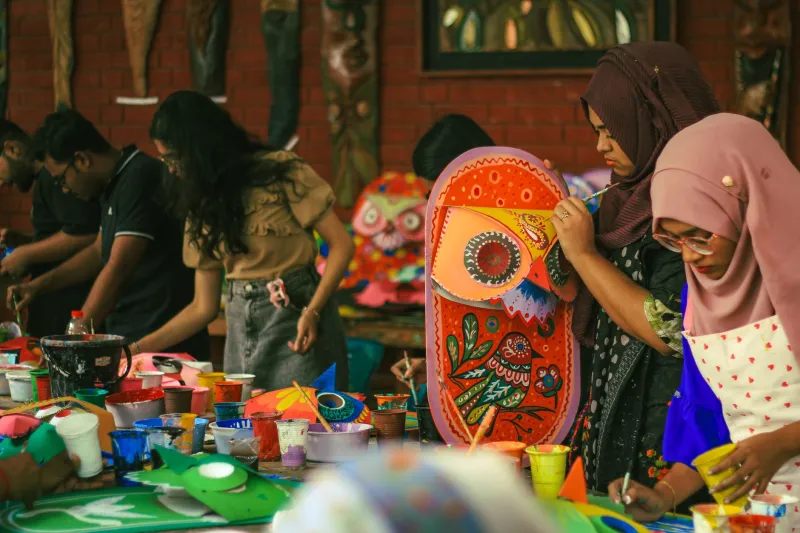
There's something happening in Nottinghamshire's village halls, community centres, and back-garden sheds — and it's got very little to do with committee meetings or membership fees. Across the county, people are gathering around shared passions with an enthusiasm that's hard to ignore. Foragers, printmakers, urban beekeepers, fermentation enthusiasts, mural painters. The list goes on, and it keeps growing.
These aren't your traditional clubs with waiting lists and blazers. They're looser, warmer, and often started by one person who simply decided to stop waiting for something to join and just made the thing themselves.
So what's driving this surge? And what does it tell us about how people in Nottinghamshire — and beyond — are searching for a sense of belonging?
The Person Behind the Group
Take Sarah, who founded a foraging and wild food collective that meets regularly around the green spaces near Hucknall. She started it after moving back to Nottinghamshire from London during the pandemic and finding that traditional ways of meeting people — work drinks, gym classes, neighbourhood associations — weren't quite cutting it for her.
"I just wanted to walk around outside with people who found the same things interesting," she says. "I posted in a local Facebook group, twelve people turned up, and it kind of snowballed from there."
That casual origin story is remarkably common. Over in Arnold, a printmaking circle that now meets fortnightly in a rented studio space above a café started in almost exactly the same way — one person, one post, a handful of curious strangers. The founder, Marcus, describes the group as "accidentally serious." What began as a few people sharing a press and some ink has evolved into a collective that runs beginner workshops, contributes prints to local exhibitions, and has even collaborated with a Nottingham city centre gallery.
"We never set out to be an arts organisation," Marcus laughs. "We just wanted to make stuff together. The rest followed."
Why the Passion-First Model Works
There's a psychological logic to all of this that's worth unpacking. Traditional community structures — residents' associations, formal clubs, religious organisations — tend to organise people around geography or obligation. You join because you live somewhere, or because you feel you should. Passion-led groups invert that entirely. You show up because you genuinely want to be there, which changes the energy in the room from the very first session.
Researchers who study social connection have long noted that shared activity is one of the most powerful bonding mechanisms available to us. It sidesteps the awkwardness of pure socialising — that slightly forced quality of a networking event or a street party — and gives people something to do together. The conversation flows more naturally when your hands are busy or your eyes are fixed on the same thing.
For many people in Nottinghamshire, particularly those who've relocated for work or family reasons, these groups are filling a gap that nothing else quite manages to fill.
The Venues Making It Possible
None of this happens in a vacuum, of course. Behind every thriving group is usually a venue that's been willing to take a chance on something a little unconventional.
In Beeston, the function room of a local pub has become an informal hub for a board game collective that draws in thirty-plus people on a good night. The landlord admits he was sceptical at first — "I thought it'd be five people arguing about rules" — but has since become one of the group's biggest supporters, setting aside the space every other Thursday and even stocking a few games behind the bar.
Libraries, too, are playing a quietly significant role. Several Nottinghamshire library branches have leaned into their community function, hosting everything from seed-swapping sessions to creative writing groups, often with minimal formality and no charge to participants. It's a model that works precisely because the barrier to entry is so low.
The challenge, as many group founders will tell you, is that suitable spaces can be inconsistent. Venues close, landlords change, room hire costs creep up. Several groups in the county have had to move multiple times, relying on word of mouth and the goodwill of local businesses to keep going.
Are Passion Groups Outpacing Formal Networking?
Here's the slightly uncomfortable question for more established community organisations: are these informal, interest-driven groups quietly doing a better job of bringing people together?
The honest answer is: in some ways, yes.
Attendance at formal networking events and traditional clubs has been patchy in recent years, with many organisations still recovering ground lost during the pandemic. Meanwhile, groups built around hobbies and creative interests have, in many cases, grown steadily — often with no funding, no committee, and no strategic plan whatsoever.
That's not to say formal structures don't have value. They offer stability, legitimacy, and often the kind of sustained support that a loosely organised collective can't always provide. But the passion-led model has something that's genuinely difficult to manufacture: authenticity. People can tell the difference between a group that exists because someone cared enough to start it and one that exists because it's always existed.
What This Means for Nottinghamshire
If you zoom out and look at the picture across the county, what you see is a community landscape that's quietly diversifying. Alongside the longstanding institutions — the sports clubs, the civic societies, the faith groups — there's a new layer of social infrastructure emerging, one that's more fluid, more niche, and in many ways more accessible.
For anyone who's ever felt that the traditional routes to community life weren't quite designed for them, that's genuinely good news.
And for those of us at Notts Groups, it's a reminder that connection takes all kinds of shapes. Sometimes it's a business card and a handshake. Sometimes it's a muddy walk through a field looking for wild garlic.
Both count.
Know a passion-led group in Nottinghamshire that deserves a bit of recognition? We'd love to hear about it — head over to nottsgroups.com and get in touch.